


Last updated: Sep 16th, 2011
GPS Units:
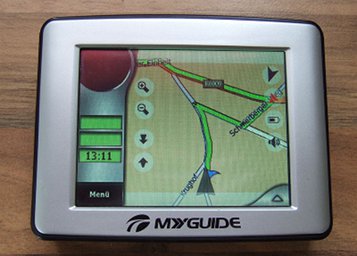
A typical GPS unit, showing only the immediate surroundings and not a broader picture of the area.
GPS, or global positioning system units are small devices, usually hand-held, which provide location features and usually, navigation.
I avoid using GPS units, and I recommend that everyone avoid them, especially for regular use, and instead use maps to navigate, or learn by direct experience (i.e. exploring areas and learning by paying attention while travelling various routes). There is evidence that regular GPS use harms spatial memory and increases the risk of Alzheimer's disease. Even ignoring these things, there is also evidence that use of a GPS results in a significantly decreased ability to navigate, relative to using maps or learning by direct experience.
Occasionally, GPS can be useful; I think the proper use of GPS is to identify and pinpoint your location, but not to navigate.
Scientific Study of the Effects of GPS Use:
Negative Impacts on Navigation Ability:
A 2008 control study by Ishikawa et al., referenced below, compared the performance of people navigating different routes on foot, breaking users into three groups: those who use GPS, those who use paper maps, and those learning routes by direct experience. This study found that GPS users performed worse at navigating tasks, as measured by a number of different outcomes. When compared to both map users and people learning routes by direct experience:
- GPS users travelled longer distances to find the goals (reflecting errors and backtracking).
- GPS users made more stops during the walks in the study.
When the performance of GPS users was compared to those learning by direct experience, the following disadvantages were found:
- Overall, GPS users travelled more slowly.
- When asked to sketch their own maps, GPS users drew maps which had poorer accuracy.
- GPS users found the navigation tasks more difficult.
Negative Impacts on Memory:
A more recent study found that frequent GPS not only harms navigation ability, but actually causes or contributes to memory problems. The current working theory is that reliance on a GPS causes a region of the brain in the hippocampus, responsible for spatial navigation, to atrophy. This not only harms navigation ability and spatial memory, but also puts people at greater risk of Alzheimer's disease. The atrophy is actually observable in a measurable reduction in the volume of gray matter.
References:
- Wayfinding with a GPS-based mobile navigation system: A comparison with maps and direct experience, by Toru Ishikawa et. al, Journal of Environmental Psychology, Volume 28, Issue 1, March 2008, Pages 74-82 - (Not public access)
- Study: GPS Units Cause Memory and Spatial Problems, DailyTech, November 16, 2010.
Comments are moderated. Follow Cazort.net's comment policy for your comment to be approved.
blog comments powered by Disqus