


Last updated: Oct 3rd, 2011
Cars:
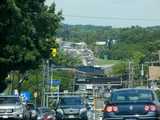
Traffic and Urban Sprawl
Over the past recent decades, America has become increasingly car-oriented. Whole neighborhoods and even cities are developed in such a way that is necessary to drive a car to get anywhere. While cars have their benefit on an individual level, it is highly damaging to society as a whole when communities are designed so as to require car use.
Here on Cazort.net, we support and advocate for design of cities and communities so that people can easily live without a car. We support making car-free leaving easy as the first priority, and then, making car use easy and convenient a second priority, as this is also important (traffic congestion also results in wasted resources, pollution, and other negative consequences). Our key point is that reducing car use is a win-win situation: when communities are designed so cars are not necessary, even car users benefit, as there are now fewer cars on the road and it becomes easier to get around by car.
Car-oriented design is inefficient and wasteful, and it also is destructive to culture and social lives. Car-oriented design has grown and thrived due to the structure of our economic system, but also due to deliberate social engineering by real-estate developers, such as William Levitt.
Negative Consequences of Car Use:
Time spent in a car is not only time that could be spent on other more fun and productive activities, but it has a number of negative consequences, including:
- Pollution - Nearly all cars burn gasoline or diesel as fuel. Cars contribute both to carbon dioxide (which contributes to global climate destabilization) and nitrogen oxides (which contributes to acid rain). On a local scale, they create smog, making the air foul smelling and harmful to breathe, and contributing to health problems such as cancer and asthma.
- Obesity - When people travel by car instead of by foot or bicycle, they become highly sedentary. Even using public transportation, such as travelling by train or bus, gets a person much more exercise than driving in a car. The excessive use of cars contributes to obesity, which is linked to other health complications such as high blood pressure, heart disease, and stroke.
- Car Accidents - In recent years, about 33,000 - 43,000 people are killed per year in America by car. [Source] This is about twice the rate of murders each year in the U.S. [Source] Far more people are injured.
- Cost - Cars are extremely expensive to purchase and maintain. The IRS (which has a strong incentive to underestimate) is 40.5 cents per mile driven: this includes all costs, such as cost of purchasing the car, gasoline, insurance, and repairs. In addition to these costs, there are hidden costs, such as the cost of maintaining parking spaces or garages (borne by homeowners or cities), and the indirect health care costs related to the problems described above.
- Disconnectedness - Sociologists such as Robert Putnam, author of Bowling Alone, have studied the relationship between cars, socializing, and civic engagement. They have found strong numerical evidence suggesting that in America, an increase in the amount of time spent driving cars is directly connected to people socializing less and being less involved in their communities. The cost of such disconnectedness to society is incalculable, and this problem is arguably the largest one caused by rampant car use.
Reducing Car Use:
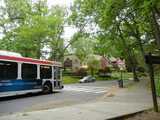
Public transportation can reduce car use.
Reducing car use is fairly easy if you set your mind on it. Some good starting points are:
- Walk & Bike When Possible - It's not possible for everyone, particularly those living in a car-oriented community, but many of us can help ourselves and our community by walking or riding a bike.
- Use Public Transportation - When we ride public transportation, we help to support the transit system. If everyone rode public transportation more, there would be much more public transportation, and this would benefit everyone.
- Choose to live near where you work - Most time in a car is spent commuting to and from work. If you live close to your work, you reduce the time spent in a car, even if you drive.
- Choose to live in a walkable community - All throughout America there are walkable communities, from small towns to big cities, to even some older suburbs. Not only are walkable communities more pleasant to live in, but they reduce your dependence on cars for shopping or recreation, even if you still have to drive to work.
Posts on my blog pertaining to cars and car use:
- A Gas Tax to Stabilize Gasoline Prices - Feb. 28, 2011 - In this post I advocate for a higher gas tax, and describe how a floating-rate gas tax could maximize the benefits of a higher gas tax while minimizing the negative impacts.
- The Joys of Through Streets - May 31, 2010 - This post explores the layout of streets in a neighborhood, arguing that a grid of through streets can reduce the need for driving cars.
Comments are moderated. Follow Cazort.net's comment policy for your comment to be approved.
blog comments powered by Disqus